
What drives JD Vance, and what’s he after?

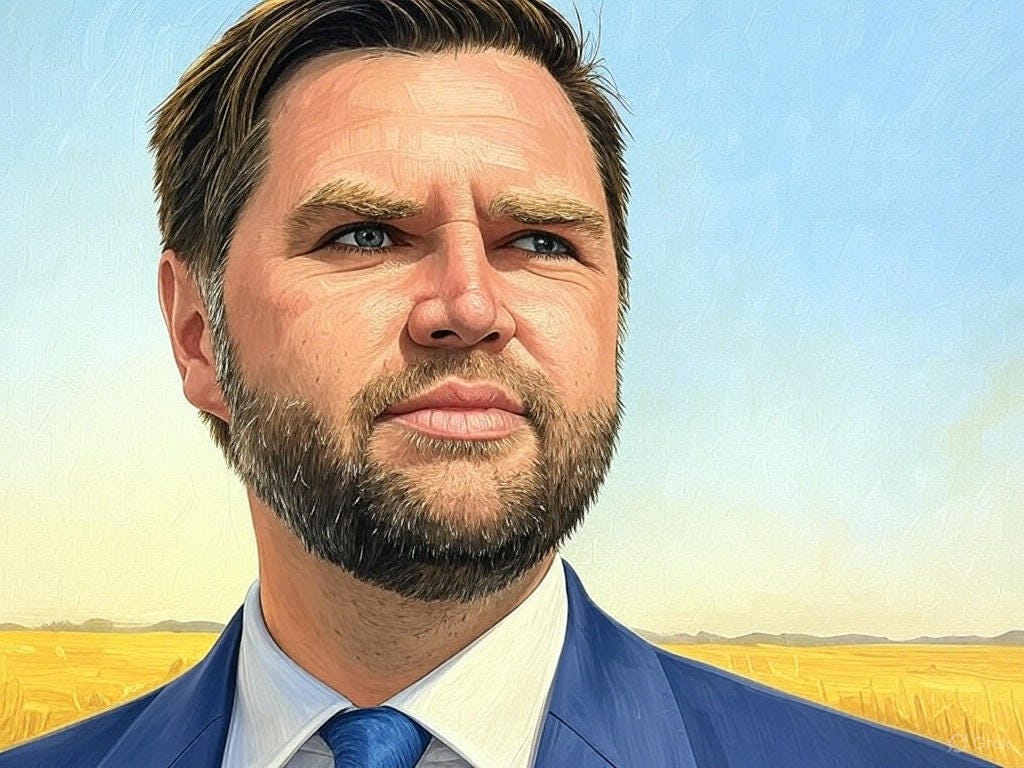
I first came across JD Vance in 2022, when it was reported that JD had entered the 2022 Midterm Senate race. His name came across my news and Twitter feeds, as JD's campaign had taken on a certain prominence due to who had donated to his campaign: Peter Thiel reportedly donated between $10m and $15m to fund JD's Senate campaign. Thiel is often discussed on Twitter/X and is ubiquitous in the news. I vividly remember that during this time, it was a completely opposite political landscape than it is now: back then it was about Republicans missing the mark now it is about Democrats falling short. David Sacks called this tumultuous period "Not a 'Red Wave,' but a 'Red Trickle.'" The Guardian wrote: "The biggest losers in the US midterm elections? Republican mega-donors…"
Two years later, in July 2024, that same JD Vance came across my feed again as then-presidential candidate Trump had announced that JD would be Trump's running mate for the 2024 Republican Presidential Ticket. At this point, I wasn't micro-analyzing JD's behaviors, but I was making observations and storing them in the back of my mind for later use. I observed that for months, the zeitgeist regarding Trump's pick of JD Vance as VP was that Trump had made the wrong choice, and many Republicans held a deep resentment toward Vance. They picked apart his old identity, noting that at one point, he called Trump "America's Hitler" and complained that JD had an extremely boring personality.
For months, Vance remained quiet and reactionary, but people's perception of him declined. The sentiment circling around Vance quickly morphed from seeing him as boring to calling him ‘weird’ riffing on Tim Walz’s words. Some of this shift was due to JD's comments related to "childless cat ladies." Michael Hopkins of the It Matters show spoke on Breaking Points, parroting views of how Vance was seen at this time, "I'd be surprised if Donald Trump is even talking to JD Vance...The problem with JD Vance is there is no real audience for him, people just don't like him…" It was even reported that JD Vance "has the worst polling for a VP pick post-convention in history." In retrospect this historic polling didn't matter, and Hopkins overestimated the influence of Vance's comments towards the mainstream.
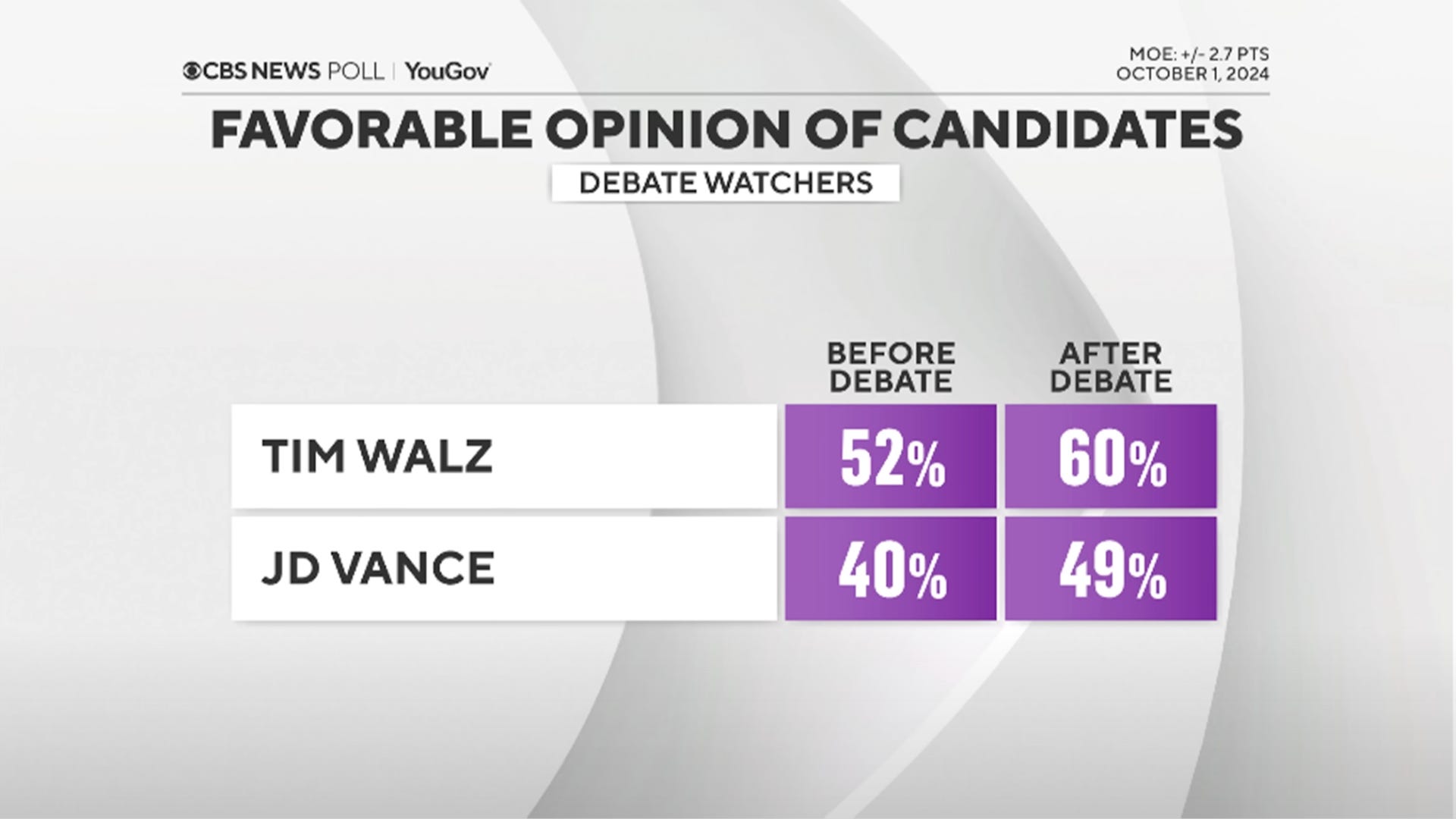
Then I noticed that at the Vice Presidential debate between JD and Tim Walz, in the time it takes to snap a finger, the zeitgeist around JD transformed again, this time from people seeing him as 'boring' and 'weird' to seeing Vance as passionate and outgoing. The significant change in attitude was driven by people believing that he was, in fact, the right person for the job. A CBS News Poll showed that his favorability increased by 9% compared to before the debate.
Building on the momentum from the debate, JD went on any and every long-form podcast with the intent of demonstrating his ability to engage in extended conversations with interviewers. This exposure revealed a compelling personality beneath his exterior, showcasing that he is someone worth watching and spending time listening to. A few comments on Vance’s podcast appearances include:
"This guy is supposed to be weird? He's like the most normal down to earth guy"
"I had preconceived notions about Vance that were put to rest by hearing him for two hours. A testament to the power of actual conversation"
"They labeled him as 'weird' and he's the most normal politician ever! I've never thought ‘I'd like to hang out with that guy' EVER about a politician, but I feel like I could actually have a conversation with JD."
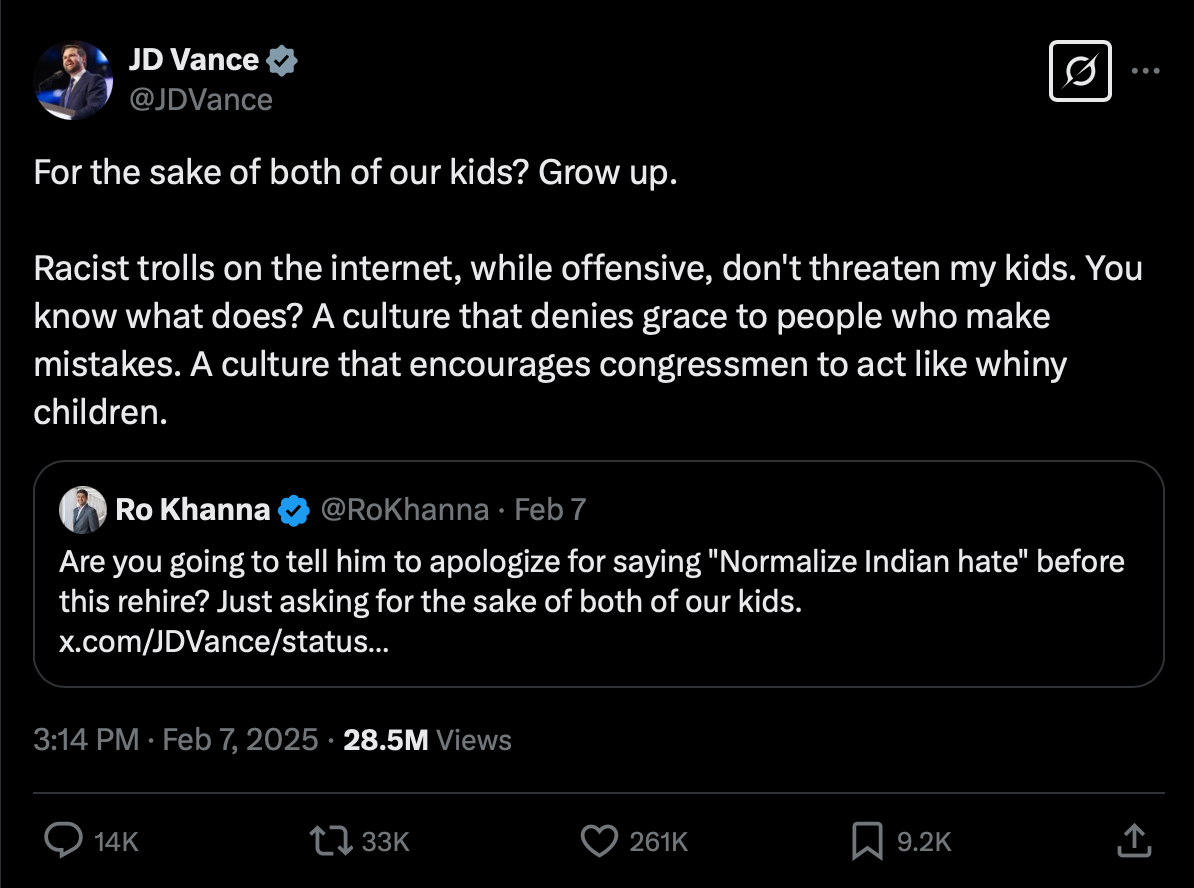
In the 'interregnum' period between the election and the inauguration, I hadn't thought much about JD, but as I was sitting on my train on the day of the inauguration, I noticed a recurring theme as I scrolled down my Twitter/X feed. JD's tide had shifted so dramatically that a new consensus had formed: prognosticators suggested that Vance is the future of the Republican Party, and he will likely lead the Republican ticket in 2028. Following that, I then observed, a few weeks into the start of the Trump presidency, that a staffer at DOGE, Marko Elez, had been fired for making racist remarks online. Vance then took to Twitter/X to defend Elez and not only defend him but call a twenty-five-year-old a "boy."

In an interview with JD Vance on the All In podcast, Vance said, "I'm married to the daughter of legal immigrants to this country, and of course, I not only love my wife but the whole extended family." When I observed Vance's behavior and his pushback to the notion that if someone is racist towards your wife and children’s ethnicity, you stand up for them. I gathered that JD is an unusual and intriguing person, and I felt that there was something underneath that was driving him or something deeper that was motivating him. For someone to portray themselves as such a family man over and over again but to defend someone who made racist remarks against his family's ethnic origins didn't quite make sense to me. I bounced around the idea that he isn't driven by emotion. The desire to "crush" the person who made racist remarks is an emotional decision, and if he acts with decorum, he gives the audience one more reason to like him.
Eventually I came upon the idea that he's trying to show the audience another side of himself, the first word in his bio: Christian. By wrapping himself in Christian themes like ‘grace’ (undeserved forgiveness) Vance increases his appeal to Christian voters.
For a few weeks, I contemplated writing this piece, so in preparation, I began to read Vance’s book, Hillbilly Elegy. But just a few weeks ago, when he was in the Oval Office with Presidents Trump and Zelensky, I observed how Vance conveyed himself, and I knew I needed to continue with this piece and find out what drives JD Vance and what is he after?
I won't lie; I came into this piece intending to discern JD Vance's ambitions or identify something that drives him from within. But the more I watched his interviews and podcasts the more I understood his perspectives. He told one interesting anecdote of a time he was on the train between NYC and law school in which he observed a mother and her children and how everyone on the train was distraught by the children. That observation led to Vance realizing that the US has become anti-child. Liz Wolfe of Reason magazine has a great piece investigating this phenomenon. Even my last piece focused on the hostility of American society toward children. I've had similar experiences in places such as the airport, where parents with young children are struggling to maintain order. Everyone just passes them by without offering to help or defuse the situation often having disdainful facial expressions.
In his book, Vance talks about the decline of his town's downtown. From Chapter 6:
"In the 1980s, Middletown had a proud, almost idyllic downtown: a bustling shopping center, restaurants that had operated since before World War II, and a few bars where men like Papaw would gather and have a beer…Today, downtown Middletown is little more than a relic of American industrial glory. Abandoned shops with broken windows line the heart of downtown, where Central Avenue and Main Street meet. Richie's pawn shop has long since closed, though a hideous yellow and green sign still marks the site, so far as I know."
I related to his sentiment as I took a class in college about the decline of main streets in America, and my final paper for that class regarded a town called Middleville that lost its downtown. Vance's housing efforts and talks about the housing crisis in the US resonated with me.
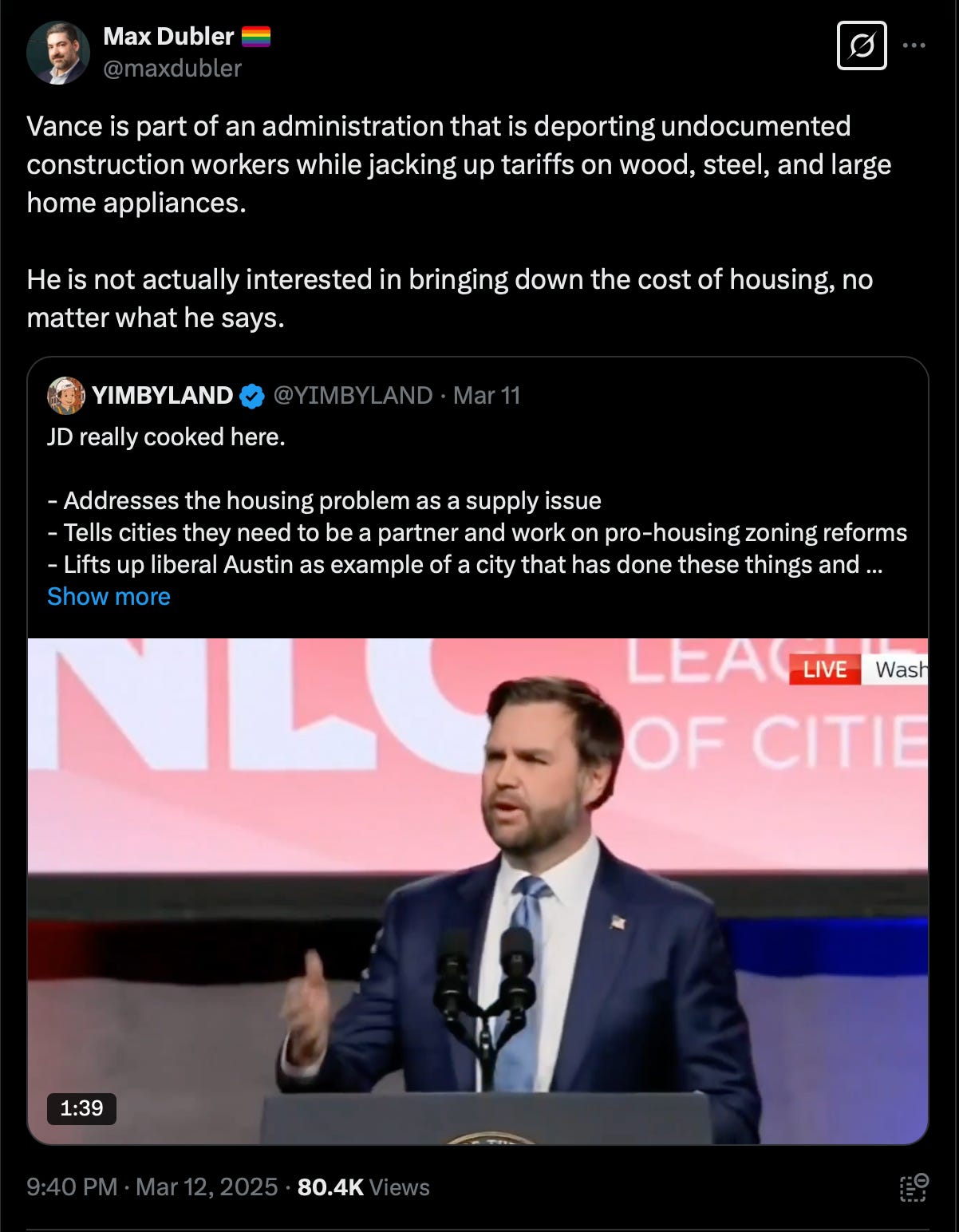
However, that is where my compatibility with JD Vance ends and I begin to take issue with his behavior. In a recent clip Vance spoke to an audience about how zoning is one of the most important issues regarding affordable housing. Vance gave an educated and thorough answer. However if you were to observe the behaviors of the Trump administration you would see an alternative reality. The Trump administration placed tariffs on steel and aluminum.
JD Vance is well read, sensitive to, and observant of cultural issues; however, his actions such as spreading rumors about Haitian immigrants reveal a duplexity in his personality. One could argue there's a contrast between his background as a former law student who worked in finance and his role as a politician aiming to resonate with voters concerns. He seeks to present himself as an intellectual who understands his constituents challenges. Yet, once he attains power, he has no regard for following through on the commitments or comments that initially propelled him to that position in the first place.
In an interview with Bari Weiss and Peter Thiel, Bari states, “Masters and Vance let's talk about them. They’re people that sort of exemplify the new right. A bit more protectionist, skeptical of immigration, furiously critical of Big Tech and also ferociously critical of China.” Bari Weiss’s comment echoes my belief of what drives JD Vance. If you type in JD Vance “New Right” online you will come across a multitude of articles positing Vance as the representative of the new right.
“Vance — whom I interviewed at length earlier this year for a profile in POLITICO Magazine — entered the national political scene in 2022 as the leading avatar of the ‘New Right,’ a rag-tag band of conservative intellectuals and activists that coalesced during the end of the Trump presidency. The New Right is largely aligned with Trump on questions of policy, including his embrace of economic nationalism, his hardline opposition to immigration, his skepticism of U.S. military involvement abroad and his escalation of the culture war at home.” - POLITICO
If you spend time on X/Twitter or YouTube/Instagram comment sections, as I mentioned previously, people will often assert that Vance is the future of the Republican Party. I speculate that Vance has managed to persuade society to believe in his potential, using his viral clips to spread his influence. The defense of the racist remarks of the DOGE employee, his lecture to European leaders, and his conduct during interactions with Zelensky, all suggest that he is astutely aware of the need to engage his audience and the populace - his need to rise above the crowd and catch people’s attention. He aims to captivate the audience and keep them pushing for his leadership just long enough to secure his title to the ‘throne’. It’s the people in comment sections that constantly push the narrative that he is the future of the party, and the journalists that claim him as leader of the new right.
As I conclude this piece I want to leave you the reader with some other observations I have regarding JD Vance’s ambitions. In Vance’s interview with Joe Rogan, Joe asks him about any resentment he has towards taking on the VP role.
“You know, even though, yeah, I'm a senator, we're still pretty anonymous, right? Like, we can go on vacation or we were till this happened or we'd go on vacation. Yeah. You'd have people stop and ask to take a photo or say something, You know. Nice. But most, most people, if you went somewhere didn't know who you were. Right now, it's, it's literally impossible for us to go anywhere.” - JD Vance
If you take a moment to observe Vance two months into the current administration, you’ll notice that he has lost a fundamental aspect of the privilege we often take for granted: anonymity. Not only has he lost that anonymity but lost a lot of freedom. Just a few weeks back, protests took place near Vance in Vermont where he had been skiing with his children on vacation. In response to the protesters, Vance tweeted:
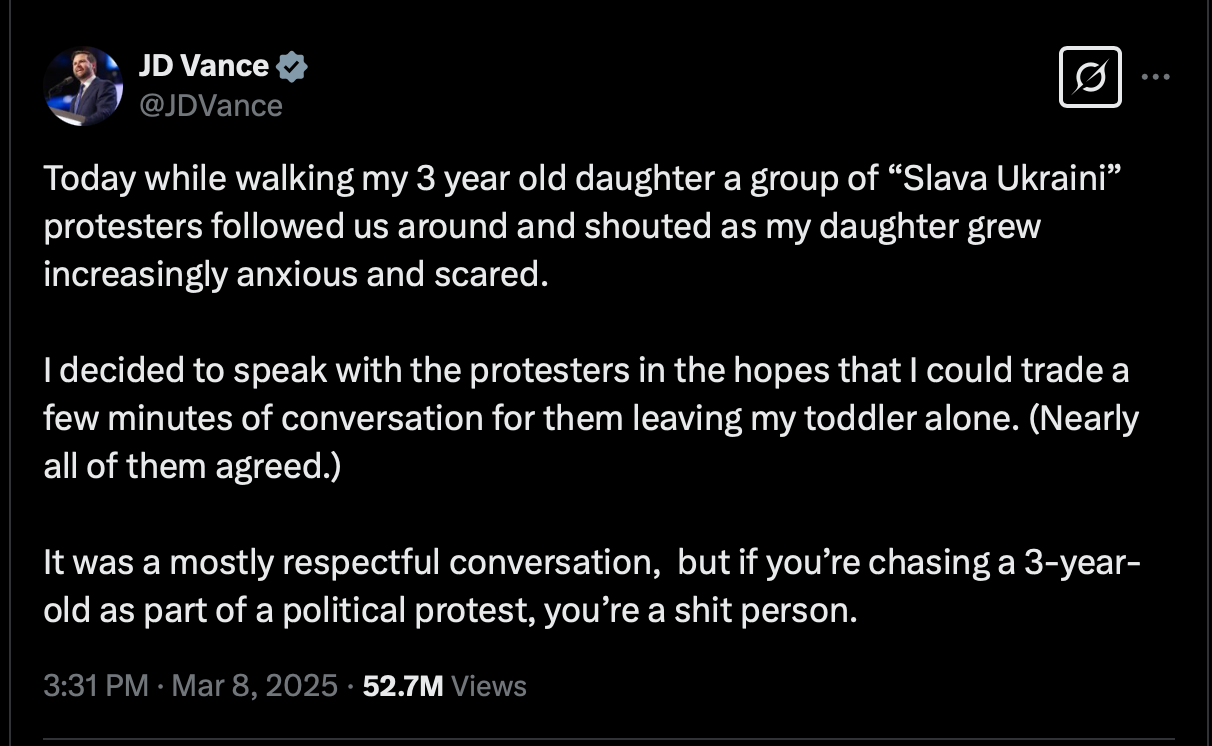
Nearly a week ago he attended the Kennedy Center for a concert with his wife where he was met with a myriad of boos from the audience. Per The New York Times,
“Instead, as Mr. Vance took his seat in the box tier with the second lady, Usha Vance, loud boos broke out in the auditorium, lasting roughly 30 seconds, according to audience members and a video posted on social media. Mr. Vance was shown in the video waving to the audience as he settled into his seat.”
Using just these brief interactions and the Rogan clip, now that we are only a few months into the administration, it is important to think about how much family matters to JD Vance. I convey it in this piece, and if you spend time watching his podcasts, you understand that he holds his children near and dear to his heart. Whatever he is after, he knows the stakes of what he is getting into, and the tradeoff of a position of power and visibility is a life without anonymity and an occasional berating—evidenced in these past two anecdotes, not only for him but for his wife and children.
“Well, it's, you just, you have to accept it. Right? But it's not easy, right? I mean, in, in particular for our kids, right? Like, okay, I really like to drive. And 99% of the time, if we're as at, in the car as a family, I'm driving, my wife's in the passenger seat just because I like to drive. And I, I think for our kids getting used to, oh, we're not going into our car, we're going into this black SUV Oh yeah. And daddy's not driving, right?” - JD Vance.
After four years, will JD Vance want to continue with this lifestyle and experiences?